
- The 8th Issue of The SportsThink Weekly Review Newsletter is UP!
- Saudi Arabia Withdraws Bid to Buy Newcastle United (had been tracking this one on the blog over the past couple months)
- More Trouble for MLB; The Cardinals This Time
- Like Something out of The Godfather, A Pig’s Head Left on a Soccer Club’s Doorstep
- NFL Corona Protocol Questions
- Inside Look at the NBA
BubbleCampus
FIFA In The News
Yesterday, FIFA announced a major relief effort, a plan to distribute $1.5 billion to its 211 member nations.
Today, the organization is in the news on a less positive note:
A criminal case against FIFA president Gianni Infantino was opened by a Swiss special prosecutor on Thursday, plunging the soccer body into a new scandal and potentially threatening the tenure of the man who was brought in to restore its tarnished reputation.
Infantino was brought on to usher in a new era, to right the wrongs of the systemic corruption that defined the Sepp Blatter years. But it seems that maybe not much has changed. This case is one to keep an eye on and I’ll share some more thoughts on the bailout plan later this week.
Will the NFL’s “virtual bubbles” burst?
Good analysis in this piece from ESPN. I imagine the league is pretty stressed out by the MLB/Marlins situation.
The Return of Fans: Looking to Germany
With the country’s COVID situation relatively under control, German soccer is hard at work to get fans back into stadiums, entertaining proposals with a staggered return of various parts of the live experience. Imperfect, but optimistic. From the linked article, via Deutsche Welle:
The main conditions revolve around limiting the number of fans, closing standing sections, stopping the sale of alcohol and providing no away fan allocation. Restrictions on traveling support are expected to remain valid until the end of the calendar year, while October 31 is seen as a potential date to lift restrictions on alcohol and standing sections.
Next Tuesday is decision day for the top 2 tiers of German soccer, will be interesting to see where the clubs land.
Trump Was Right: Protests Did Negatively Impact NFL TV Viewership
But there wasn’t a major economic impact. From a new paper in the Journal of Sports Economics, by Judah Brown and Brandon Sheridan. The full abstract:
The National Football League’s (NFL) television ratings decreased by approximately 8% during the 2016 season, then a further 10% the following season. These declines coincided with league-wide national anthem protests initiated by Colin Kaepernick at the beginning of the 2016 season. Existing research identifies many determinants of demand for sporting events, but athletes’ protests are seldom considered. We use detailed data on players’ protests and television ratings to construct a new, game-level panel for the four NFL seasons between 2014 and 2017. Our results show protests are statistically significantly associated with lower TV ratings, but the economic magnitude is relatively muted.
Article here, but you might need institutional access. It’s also worth noting that viewership declines might be overstated because we don’t really have great data on illegal streaming, an increasingly popular option, especially for younger viewers. Furthermore, other research suggests that while there are fewer people watching football, those who do still watch are consuming more than ever.
No Bubble? Looks Like Trouble
MLB returned with much fanfare last week, but it looks like the baseball season is already in trouble, with a dozen positive tests and a cancelled game for the Miami Marlins. I understand that the logistics of baseball made a “bubble” concept rather challenging, but these early returns are pretty damning. Maybe they should have considered a couple bubbles, if one big one was simply too much to handle? I don’t think one outbreak on a team will be enough to cancel the season, but a couple more scenarios like this and it becomes increasingly difficult to imagine how the full (abbreviated) baseball season will be able to continue.
Congratulations Houston Dash, NWSL Challenge Cup Champs!
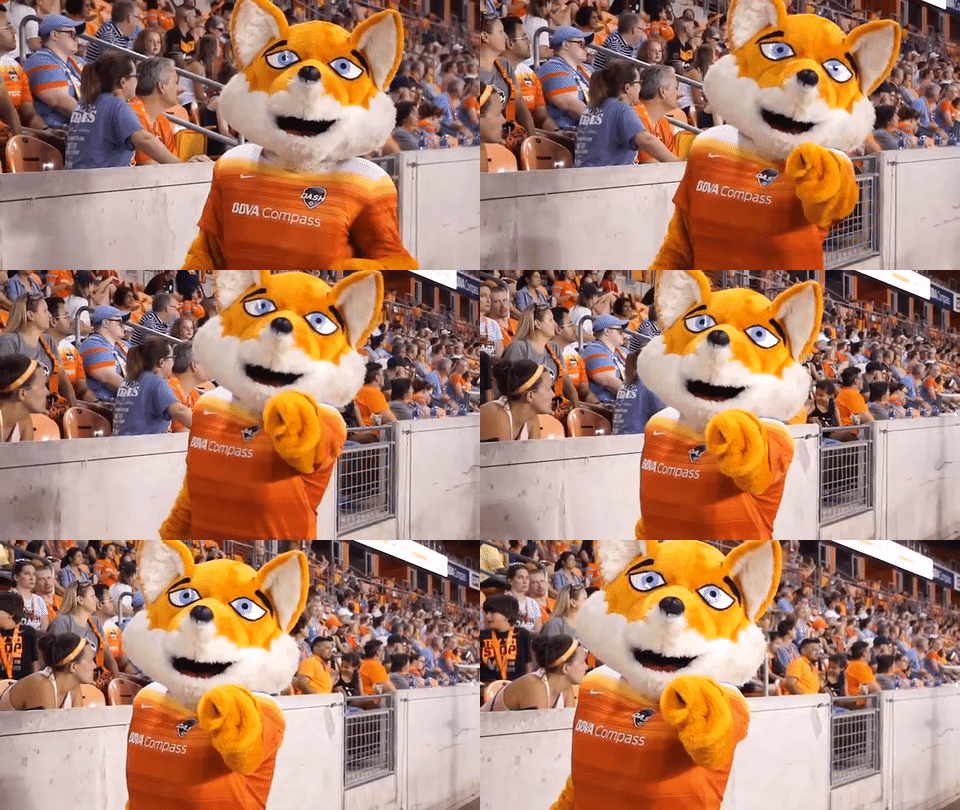
Houston knocked off Chicago 2-0 in a pretty entertaining match, winning their first title. Congrats are also in order to the NWSL for completing the first pandemic “bubble” season in North America. Pending the final round of tests, the league will have pulled off the tournament with 0 positive COVID tests. Well done all around.
Bumps in the Road for Boxing
Much has been made about the contentious preseasons in MLB and the NFL, as players’ unions, league leadership, and owners negotiated a path toward these most unusual seasons. But boxing is a different beast, where promoters make matches and there are no union protections for fighters. Last month on the blog, Jose Izquierdo celebrated the return of boxing, while noting likely challenges, especially the tension between promoter’s desire for fighters to take big purse cuts (to offset revenue losses from a lack of fans in arenas) and boxers’ expectations that contracts are upheld. This is now playing out with some of the sport’s biggest names, with both Terence Crawford and Canelo Alvarez taking vocal stands against the possibility of taking reduced pay for upcoming bouts. I reached out to Izquierdo for his take on these developments and his chief concern is that there simply might not be enough money in the short-term to make pre-COVID purses viable. TV ratings have been good–but not great–and we’re still a ways off from any meaningful gate receipts. My expectation is that fights will go on for lower-ranked fighters; some money is better is none and they need to keep fighting to stay sharp and move up the ranks. On the other hand, I wouldn’t be surprised if some of the bigger names hold out if their demands can’t be met. They can afford to wait and the potential risk of losing a low-money bout might simply be too high.
RIP Derek Ho
The surfing world lost a real one last week, with former world champ Derek Ho suffering a heart attack and passing away at 55.
Here he his, still ripping it up in the last couple years. RIP Mr. Ho.
Why Are We Against Doping? (Part II)
Part I of this post can be found here.
To summarize part I of this post, there are five traditional, consensus arguments against doping: it’s not natural, it harms the athlete, it creates an un-level playing field, it is coercive, and it may influence kids to dope. (Of course, these aren’t the only arguments, but they are the biggies.) Each argument can be undermined and fairly challenged, but it seems fair to say that the rationale for our current anti-doping approach comes from a holistic, utilitarian acceptance that the total negatives presented in the traditional arguments outweigh the positives. But is this a good enough basis to be against doping? I’ll return to this in a moment.
But first, can we entertain any arguments in favor of doping? As with arguments against, there are several, but I’ll limit myself to two.
The Cases For Doping
- Doping is a technological advancement, in service of pushing the limits of human potential. We seem to be pretty OK with the use of technology in sports performance. When we hear the term “technology,” we tend to think of cutting-edge machines, of computers, iPhones, and the like. But that’s a pretty limited view. Let’s instead take philosopher Sigmund Loland’s definition, that technology refers to any “human-made means to reach human interests and goals.” Under this umbrella, Loland suggests that even bodily techniques may be rightfully considered as technological advances. Say, for example, the flip-turn in swimming, or more famously, the Fosbury Flop in the high jump.
Moving away from bodily techniques, it doesn’t take long to grasp the breadth of acceptable technological advancement in sport. Nutritional supplements, medical procedures (e.g., LASIK, preemptive Tommy John surgery), hyperbaric chambers, all manner of wearable physiological tracking and measurement devices, and the massive category of the tools we use to play the games themselves: from cutting edge running shoes and golf clubs to sticky football gloves and compression wear, and all points in between and beyond.
Most of us are OK with all of these things. We don’t expect the modern athlete to wear glasses in lieu of LASIK, nor do we expect them to play basketball in Chuck Taylors when Nike has invested the GDP of many a small nation in crafting the best basketball shoe possible. Hardcore traditionalists may disagree, but it’s hard to argue that most of these advances haven’t made sports better. If not better, they have certainly made sports a realm where we can enjoy the flow of human progress: is there any tennis fan who longs for the day of a heavier racquet that made the one-handed backhand all but impossible for most players?
I trust that you see where this all lands. Those who make the doping-as-technology argument feel that we’re being arbitrary with the limits we are placing on technological advancement in service of human potential. Their basic argument is along the lines of, “I can alter my body through surgery or a training program generated by artificial intelligence, but I can’t alter it pharmaceutically. What gives?”
It’s a compelling case, but not a perfect one. Counter arguments to this hinge on one of two approaches. First, we DO limit technology in sports. A football glove that is too sticky, a hockey stick that is too curved, or a basketball shoe with a spring-loaded mechanism: none of those things are allowed. There are regulations governing golf balls and bathing suits, so there can be regulations governing performance enhancing drugs. The second approach circles back to the original five anti-doping arguments, in an attempt to show that non-doping technologies don’t raise the same concerns as doping: it’s hard to say that wearing a $300 soccer boot hurts children, harms the athlete, or un-levels the playing field. There is merit in both counter-arguments, but the former is a bit more convincing. - Doping is bad, but doping control– as we know it — sucks. What’s wrong with current anti-doping policy and practice? Critics might fairly make some of the following arguments: it is corrupt, biased, violates rights to privacy, disproportionately punishes poorer athletes and countries, forces athletes to engage in risky underground economies and medical practices, and, perhaps most importantly, doesn’t seem to work that well. After all, we’ve had some five decades of doping control and there is still plenty of doping. For a much more in-depth and elegant articulation of this position, I defer to Patrick Hruby’s takedown of anti-doping, “The Drugs Won: The Case for Ending the Sports War on Doping.” A very thorough and essential read if you’re interested in the subject.
 SportsThink